Contents
- 1 Why the Basement Door Has an Outsized Energy Impact
- 2 The Role of Door Construction in Thermal Performance
- 3 What Makes an Insulated Basement Door Effective
- 4 Energy Saving Doors: Understanding the Long-Term Financial Case
- 5 Choosing Between Flush and Shaker Profiles for a Basement Door
- 6 Installation Considerations Specific to Basement Doors
- 7 How Door Quality Connects to Overall Home Value
- 8 Additional Benefits of Upgrading the Basement Door
- 9 Maintaining Your Basement Door for Sustained Performance
- 10 Conclusion
- 11 FAQs
- 11.1 Q: Why is the interior door for basement spaces so important for energy efficiency?
- 11.2 Q: What makes a door qualify as an insulated basement door?
- 11.3 Q: Are solid core interior doors significantly better for basement use?
- 11.4 Q: How does a basement door contribute to energy saving in both winter and summer?
- 11.5 Q: Can the basement door be replaced without professional installation?
Most homeowners invest in insulation, windows, and HVAC upgrades when trying to improve their home’s energy efficiency, but the interior door for basement spaces is frequently overlooked. This single opening connects one of the coldest zones in a home to the main living area above it. When that door is poorly constructed or improperly fitted, it becomes a consistent source of heat loss, drafts, and elevated energy costs that accumulate quietly over every heating and cooling season.
Choosing the right door for a basement opening is a straightforward improvement that delivers measurable results. This guide explains how the door connecting your basement to your living space affects thermal performance, what construction features matter most, and how to select a door that genuinely contributes to a more energy-efficient home.
Why the Basement Door Has an Outsized Energy Impact
Basements are naturally cooler than the floors above them. Even a finished and conditioned basement maintains a lower ambient temperature than the main living level. An unfinished or unconditioned basement is significantly colder in winter and can contribute to uncomfortable floor temperatures, drafts at ground level, and a heating system that works harder to compensate for the constant cold air exchange.
The door separating the basement stairwell from the main floor is the primary barrier between these two temperature zones. If that door is a lightweight core unit with gaps around the frame, it provides almost no meaningful resistance to thermal transfer. Cold air from below migrates into the living space. Warm air from the heated living area flows downward into the basement. The heating system runs more frequently to maintain the temperature setpoint, and energy bills reflect that added workload.
Upgrading to a well-constructed interior door for basement use is one of the more direct ways to address this heat exchange without undertaking major renovation work. Understanding how to choose the perfect interior door for your home begins with matching door construction to the specific demands of each opening, and the basement stairwell is one of the most demanding locations in any home.
The Role of Door Construction in Thermal Performance
Not all interior doors perform equally when it comes to resisting heat transfer. The difference comes down to what sits inside the door slab and how well the door is sealed within its frame.
A hollow core door contains an internal skeleton of lightweight material surrounding large air cavities. Those cavities do not provide insulation. Air can convect within the hollow space, and the thin surface layers offer minimal resistance to the movement of heat between the warm and cold sides of the door.
A solid core door, by contrast, contains a dense composite or hardwood core throughout the full thickness of the slab. This mass slows thermal transfer in both directions. Heat from the warm side of the door must work through a substantial volume of dense material before it can reach the cold side. The same principle applies in reverse during the cooling season when the basement may be cooler than the living space above.
The denser the core material the better the door performs as a thermal barrier. This is the same principle that makes thick walls more energy efficient than thin ones. Mass resists the transmission of both sound and heat, and solid core construction delivers meaningful quantities of both.
For a comprehensive look at how solid core construction affects both acoustic and thermal performance read about the benefits of choosing solid core doors for your home.
What Makes an Insulated Basement Door Effective
The phrase insulated basement door refers to a door that is specifically selected and installed to minimize thermal exchange between the basement and the living area above. Several construction and installation factors contribute to how effectively a door achieves this.
Core density is the foundation of performance. As discussed, solid core construction provides the mass needed to resist heat transfer. A door specified for a basement opening should always be built around a dense core rather than a hollow or semi-hollow alternative.
Surface layer quality also plays a role. A door with a substantial wear layer, such as a quality MDF or hardwood veneer surface, adds to the overall thermal resistance of the assembly. Thicker and denser surface materials contribute to the door’s ability to moderate temperature exchange.
Frame fit and installation precision are equally critical. A door that is correctly sized to its frame and hung with proper clearances leaves minimal gaps around the perimeter. Those gaps are where air infiltration and thermal exchange actually occur in a practical installation. A door with excellent core construction but poor frame fit will still allow cold air to pass through the spaces that a well-fitted door would seal.
Weather stripping around the frame perimeter closes off the gap between the door slab and the frame when the door is in the closed position. A door sweep or automatic bottom seal at the base of the door addresses the gap at floor level, which is often the largest single point of air infiltration in a door assembly.
Together these elements, core construction, surface density, precise fit, and perimeter sealing, define what an effective insulated basement door looks like in practice. You can also explore how this approach applies to other energy-sensitive areas of the home by reading about commercial interior doors for offices and energy efficiency.
Energy Saving Doors: Understanding the Long-Term Financial Case
The term energy saving doors reflects a practical reality. A door that reduces thermal exchange between zones requires the heating and cooling system to do less work to maintain comfortable temperatures throughout the home. That reduced workload translates directly into lower energy consumption.
Over a single heating season the savings from one well-chosen door may appear modest. However, over the full lifespan of a door installation, which for a quality solid core door can extend to several decades, the cumulative savings become significant. Consider that the basement door is in use year round. During winter it holds warm air in the living space. During summer it limits the amount of conditioned air that migrates into an unconditioned basement. That year-round performance compounds the financial benefit of the upgrade.
For homeowners who are also considering energy efficiency improvements more broadly, the basement door is often one of the more cost-effective interventions available. Unlike window replacements or HVAC upgrades, a door replacement is a relatively contained project with a clear and measurable outcome. The energy saving doors category reflects this practical value, and the basement stairwell opening is one of the first places where this category of door deserves consideration.
Choosing Between Flush and Shaker Profiles for a Basement Door

Beyond construction type, buyers also need to select a profile that works within the visual context of their home’s interior. The basement door is typically visible from a hallway, kitchen, or main living area. It should align with the style of the surrounding interior rather than appear as an afterthought.
Flush Doors
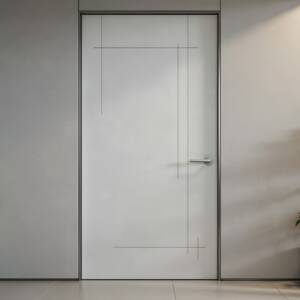
A flush door presents a completely smooth and flat surface with no panels or raised elements. This profile integrates cleanly into modern and contemporary interiors where simplicity and visual continuity are the governing design principles. In a hallway where the basement door sits alongside other room doors, a flush profile in the same finish creates a seamless and cohesive appearance.
Flush doors are also straightforward to paint and maintain. Their smooth surface accepts any color cleanly and is easy to wipe down regularly. For a basement door that may be in a transitional area of the home, this low-maintenance quality is a practical advantage.
Shaker Doors
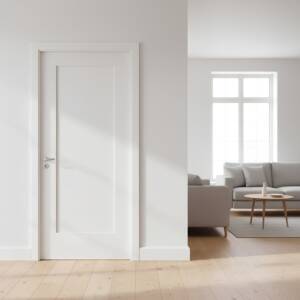
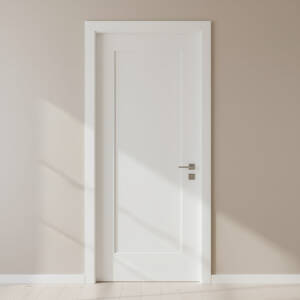
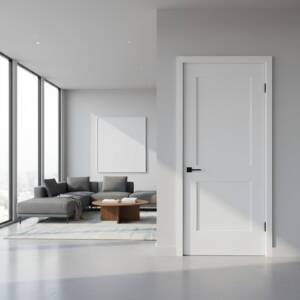
A shaker door features a recessed center panel within a simple rail and stile frame. This profile carries a subtle architectural character that suits transitional, farmhouse, and craftsman-style interiors. If the rest of the home’s doors use a shaker profile, maintaining that consistency at the basement opening creates a more unified interior.
The shaker style is versatile enough to work across a wide range of color palettes and hardware choices. It can be painted in a neutral tone to recede within the surrounding space or finished in a contrasting color to function as a deliberate design element.
For a full comparison of these two profiles and their respective strengths read shaker vs. flush doors: which one is right for your space.
Installation Considerations Specific to Basement Doors
Installing a door in a basement stairwell opening presents a few specific considerations that do not apply in the same way to standard room doors. Addressing these during the installation process ensures that the door delivers its intended performance from the start.
Moisture management is one of the most important factors. Basements are typically the most moisture-prone area of a home. While solid core interior doors built from engineered composite materials handle typical indoor humidity well, the installation environment should be considered. The door frame and surrounding finish materials should be in good condition. Any existing moisture issues in the basement should be addressed before a new door is installed so that the new unit is not exposed to conditions that could compromise it over time.
Swing direction deserves attention in a stairwell opening. A door that swings incorrectly over a staircase creates a safety hazard. In most configurations the door should swing into the living area or parallel to the wall rather than over the stair treads. Confirm the swing direction before ordering the door to ensure the hinge side is on the correct side of the frame.
Level and plumb installation is essential for proper sealing. A door that is hung out of level or plumb will not maintain consistent contact with its weather stripping. This allows air infiltration at the uneven edges and reduces the thermal performance of the assembly.
For guidance on avoiding common installation errors read the biggest mistakes to avoid when installing a new interior door.
How Door Quality Connects to Overall Home Value
A home’s energy performance is an increasingly relevant factor in how properties are assessed and perceived by buyers. Upgrades that reduce energy consumption and improve thermal comfort contribute to a more marketable property. Interior doors are part of this picture, and the basement stairwell door, due to its position at a significant thermal boundary, is one of the more impactful individual door upgrades a homeowner can make.
A well-specified door in this location signals to buyers that the property has been maintained with attention to detail and performance. It also contributes to a more comfortable living environment that buyers experience directly when they visit the property. Taken together with other quality upgrades, it supports a stronger impression of overall build quality and care.
Read more about how interior door quality contributes to property value in this guide on how high-quality interior doors can increase your home’s value.
Additional Benefits of Upgrading the Basement Door
Beyond thermal performance, a quality door at the basement opening delivers several additional benefits that are worth considering alongside the energy efficiency case.
Acoustic separation is one of these. A basement used as a workshop, laundry room, home gym, or utility space generates noise that travels up into the living area. A solid core door at the top of the stairwell reduces how much of that noise reaches the main floor. This is the same acoustic principle that makes solid core doors the preferred choice for bedrooms and home offices. You can explore this in more depth by reading about the best interior doors for soundproofing and privacy.
Safety is another consideration. In attached garage and basement configurations, fire-rated door specifications may apply depending on local building codes. Even where a specific fire rating is not mandated, a solid core door provides a more meaningful barrier between spaces than a hollow unit in the event of a fire.
Odor and air quality management also benefit from a well-sealed door at the basement opening. Basements can harbor musty air, paint fumes, or the odor of stored materials. A properly fitted door with effective weather stripping limits how much of that air migrates into the main living space.
Maintaining Your Basement Door for Sustained Performance
Once installed the basement door requires periodic attention to maintain its energy performance over time. Weather stripping is the most maintenance-sensitive component. It compresses and degrades with use and should be inspected annually. When it no longer creates a firm seal around the perimeter of the door it should be replaced promptly.
The door sweep at the bottom should also be checked regularly. It is the most exposed component in the assembly and is subject to contact with the floor on every open and close cycle. A damaged or worn door sweep allows air infiltration at the base of the door which undermines the overall sealing performance of the installation.
The door surface should be cleaned regularly and repainted when the finish shows signs of wear. A well-maintained paint surface protects the underlying material and keeps the door looking consistent with the rest of the home’s interior.
For a full maintenance guide covering all interior doors in the home read how to maintain your interior doors for long-lasting durability.
Conclusion
The interior door for basement spaces is one of the most energy-relevant doors in a home. Its position at the boundary between a naturally cold zone and a heated living area makes it a direct factor in thermal performance, comfort, and energy costs. Choosing a solid core door with appropriate sealing and precise installation addresses the heat exchange that an inadequate door allows to occur continuously throughout the year.
Beyond energy efficiency, the right door at this location also provides acoustic separation, improved air quality, and a more finished and cohesive appearance in the area where the basement stairwell meets the living space.
Evolux Doors offers a premium selection of flush doors and shaker doors built with solid core construction suitable for this and any other interior application. To review available specifications and sizing options request our product catalogue or submit a wholesale inquiry for larger project orders today.
FAQs
Q: Why is the interior door for basement spaces so important for energy efficiency?
A: The basement is one of the coldest zones in a home. The door separating it from the main living area is a direct thermal boundary. A poorly constructed door allows cold air to migrate upward and warm air to escape downward, forcing the heating system to work harder and increasing energy costs throughout the year.
Q: What makes a door qualify as an insulated basement door?
A: An insulated basement door is typically built with a dense solid core that resists thermal transfer between the cold basement and the warmer living area above. Combined with proper weather stripping around the frame and a door sweep at the base, the assembly limits air infiltration and heat exchange at that opening effectively.
Q: Are solid core interior doors significantly better for basement use?
A: Yes, solid core interior doors are a great choice for basement use. These doors are made with dense composite or hardwood material throughout, which helps to slow both heat transfer and sound transmission. Their solid structure provides better insulation, making them more effective in maintaining temperature control and reducing noise.
Q: How does a basement door contribute to energy saving in both winter and summer?
A: In winter a well-constructed basement door limits the upward migration of cold air from below, reducing heating load. In summer it limits the exchange of cooled air from the conditioned living space into an unconditioned basement. Year-round performance across both seasons makes this upgrade consistently cost-effective over the lifetime of the installation.
Q: Can the basement door be replaced without professional installation?
A: Replacing a basement door is manageable for a confident DIY installer. However, professional installation is worth considering because precise level and plumb hanging is essential for the door to seal properly. Any gaps created by an imprecise installation will reduce the thermal and acoustic performance that the door is selected to provide.